Anna Thorwald's Murder and the Concealment of Her Body
Rear WindowAnna Thorwald's murder and the concealment of her body become legible to Hal Jeffries through clues that initially seem disconnected: an empty bed, a vanished trunk, and a momentary mismatch between two people moving past apartment windows. The crime's decisive concealment is spatial: Lars Thorwald hides Anna beneath the cement kitchen floor of the unfinished apartment above his, outside the flat the police search. Jeffries's eventual reconstruction distinguishes the confirmed discovery of her body from the conjectural account of how Lars killed her and prepared a false story of departure.
Background and First Signs
Jeffries's suspicion takes shape when Lars turns over the beds and the mattresses prove empty. For two days, Jeffries has felt an unease that repeatedly fails to settle into a clear thought; small reassuring details, including the raising of shades after they have been down for an unusually long time, keep diverting it. The empty mattresses become the point of contact. Jeffries recognizes that Anna is no longer there and feels certainty of murder arrive before he can reason it through. He also forces himself to acknowledge the limit of what he knows: he has not seen Anna, but her absence alone does not establish what happened to her.
As the suspicion develops, Lars's movements and the missing trunk become part of the picture. Jeffries watches Lars leave, then sees two men enter the apartment and search it systematically, working from the bedroom and kitchen toward the living room. They leave when Lars returns, frustrated and apparently finding nothing. Jeffries is not surprised by their failure: the trunk has already gone, and he has not expected incriminating evidence to be left in Lars's flat. The episode reinforces the distinction between searching the apartment and locating Anna; the investigators' thoroughness cannot help if the body is concealed elsewhere.
Concealment and the False Departure
The eventual account of the murder's circumstances comes from Jeffries as a theory, not as a directly witnessed sequence. He says Anna had been in poor health for years and Lars had been out of work; he imagines that Lars may have tried to poison her gradually, perhaps hoping to avoid leaving evidence. Jeffries speculates that Anna caught on to what was happening on the night Lars kept a light on, and that Lars then killed her violently, abandoning the slower plan. The exact method and sequence remain conjectural in his reconstruction.
Jeffries connects the concealment to construction work in the Rear Apartment on the Fifth Floor at 525 Benedict Avenue. The apartment above Lars's was still being worked on, and its kitchen floor had been raised above the level of the other rooms. Jeffries reasons that Lars used the unfinished cement: he opened a space wide enough for Anna's body, placed her there, and covered it with fresh cement. He suggests that the floor may have been raised further to conceal her securely. In his grim formulation, the finished floor became a permanent, odorless coffin. Workmen later covered it with cork surfacing without noticing what lay beneath.
The concealment formed only part of an attempted false departure. In Jeffries's conjectural reconstruction, Lars sent an accessory upstate with the trunk keys, to a different farmhouse near a place Anna had visited in summers past, and forwarded the trunk after her. Lars also mailed a previously used postcard whose year-date was blurred. The intended story, as Jeffries understands it, was that Anna had left, later died by suicide, and left her clothes beside deep water. He considers the plan risky, but believes it might have supported an insurance claim. These proposed details explain the missing trunk and the effort to create traces of travel, but Jeffries presents the supposed insurance motive and the staged death as inference rather than established fact.
The Clue in the Windows
The break in the case comes from a brief accidental synchronization. Jeffries sees a renting agent and prospective tenant touring the sixth-floor apartment while Lars is visible below. Both pairs move from living-room windows toward kitchen windows, each disappearing behind an intervening wall before appearing again. The movement seems almost perfectly parallel, but something about it feels wrong to Jeffries. He cannot initially recover the detail, and the moment passes without repeating.
Later, the memory resolves into a vertical discrepancy. The renting agent appears taller in relation to Lars at the kitchen window than he had at the living-room window. Their timing has not changed; their relative vertical alignment has. Jeffries recognizes that the clue points to a raised floor between the apartments. Because the sixth-floor apartment has already been completed while the intervening apartment is still under construction, he concludes that the raised cement kitchen floor must be in the apartment immediately above Lars's. The construction feature that helped hide Anna has also altered the windows' apparent alignment, exposing the hiding place to observation from across the way.
This recognition is another instance of what Jeffries calls delayed action: an observation registers before its meaning does, then returns with force once his mind connects it to other evidence. The case's solution depends not on a direct view of the concealed body but on the belated interpretation of a small visual irregularity. The domestic windows that had made Lars's movements observable also supply the geometry that locates what those movements had concealed.
Discovery and Aftermath
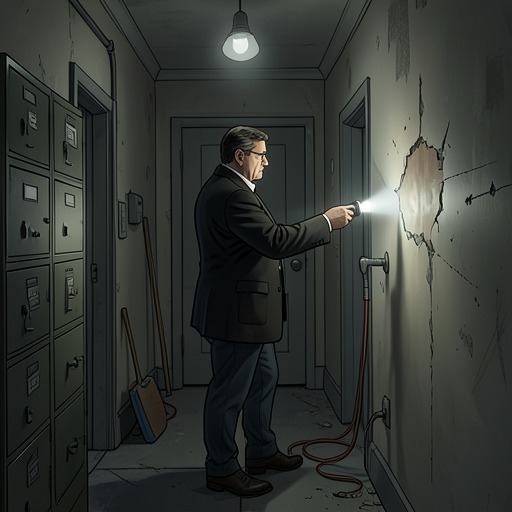
Jeffries reports the inference to Inspector Boyne and identifies the raised cement kitchen floor in the unfinished apartment above Lars's as the place to investigate. Boyne goes there with the others, using torches because the electricity has not yet been connected. About half an hour later, a signal from the window confirms that they have found what Jeffries expected. The body is no longer only an inference from Anna's absence and the building's altered levels: the search establishes that she was concealed beneath the floor.
The discovery confirms the essential fact behind Jeffries's suspicion while leaving parts of his reconstruction unverified. His account of slow poisoning, Anna's possible discovery of it, the circumstances of the killing, and the insurance scheme remains explicitly speculative. What the physical search confirms is the hidden body and its location. The crime's resolution thus turns on a sharp difference between explanation and proof: the altered floor and the recovery establish where Anna was concealed, while the story of how Lars planned the murder is Jeffries's attempt to make the scattered clues cohere.